
Career Advice

March 25, 2026
.png)
Photo courtesy of Lou Rochdi, design by Nareh Nersisian.
Breaking into the music industry rarely follows a straight path. For Lou, the journey took her many places - from her home in France to Los Angeles, then all the way to London. What started as a leap of faith quickly turned into hands-on experience in the touring world, a Coachella internship, and even the creation of Gen Admission! Along the way, mentorship and genuine curiosity helped shape a career that eventually led from touring logistics to the creative world of artist management. Read below to see how she got to where she is today.
LR: It all started in 2021. I was studying Economics at a college back home, when I realized my love for music went beyond listening to records. So, I paused my studies, packed my bags and moved to Los Angeles to do a one-year course in Music Business at UCLA Extension.
I’m the daughter of two math professors and breaking into the industry in France felt nearly impossible with no connections, no real courses or opportunities. LA sounded like my best shot. It was a big (and expensive) move, so I treated every day like it counted, chasing any opportunity I could.
Luck, timing, and a little persistence played their part. Before the move, I joined a mentorship with 1520 Vision and was paired with tour manager Lotje Horvers who became the first person to truly open a door for me. Six months into LA and long after our mentorship ended, she introduced me to the founder of LobbyCall, a touring production company. That led to an internship at Coachella and a few months later, I was hired full-time. Over the next two and a half years LobbyCall taught me everything to know about touring.
Eventually, I felt ready for the next adventure. I wanted to focus fully on Production Management, when one day, I got a call from one of my favorite PMs, Mark McNeill. But it was not what I expected, it had nothing to do with production. Instead, the artist he worked with needed a day-to-day manager. It wasn’t the plan, artist management wasn’t on my radar (I was a touring girl at heart), but my calendar was free and I thought: why not take the interview? I was hired shortly after and in taking the job I realized how much I had missed being creative. Touring is highly logistical and very repetitive. Management is the total opposite. It really turned out to be the best decision I could’ve made (and it was so not the plan)!
Looking back, Lotje and Mark opened doors to opportunities I had zero qualifications for, and Lobby Call and my current team took a big chance on me. I’m so endlessly grateful for their trust, I wouldn’t be here without them.
LR: Gen Admission taught me more than any internship ever did, and I still use those skills daily. Building our educational resources in 2021 and interviewing industry professionals gave me a big-picture understanding of how the music industry actually works, who is doing what (especially labels and artist teams) which has been invaluable, especially now that I’m in management.
It also trained me in project management, how to manage a team, delegate work, lead people with different strengths, and track progress to get to the final result. It made me unafraid of having big ideas because truly, no idea is ever too big if you can divide it into smaller parts.
It also gave me some of my closest friends in the industry, my go-tos for advice, reality checks, and bouncing off ideas. We all started as students with no experience, and now we’re working full-time in different corners of the music world. Even though none of us are “senior” on paper, I’m constantly amazed by their knowledge and instincts. They often teach me lessons that feel more practical, up-to-date, and honest than anything you’d get from a seasoned executive. I think they’re half my brain at times, a built-in sounding board I completely trust. I still learn from them every single day, and that’s probably one of the most valuable things Gen Admission gave me.
“No idea is ever too big if you can divide it into smaller parts.”
LR: Let me start by saying, no day is ever the same. That’s the biggest difference between touring and management. On tour, you level up fast. In two weeks, you’ve done seven to ten shows. If you mess up, you get a redo the next day. In management, the cycles are longer and constantly changing. You might prep an album release every couple of years, a music video every six months, and no two projects are ever the same, you’re never launching the same album twice or creating the same artwork again.
While it’s hard to define a “typical” day, I can say that my job is at the intersection of creative thinking and logistics. I work closely alongside the artist across a wide range of things from co-creating and co-editing content to helping plan the different social-media outputs, coordinating travel, and keeping the calendar and task list in order.
Not every Day-to-Day Manager has such a content-heavy role – I wasn’t originally meant to. But because I came in with a background in graphic design and video editing, I naturally leant into it. I’m really grateful my team shaped the role around my strengths, because it has made every day more creative, and honestly, a lot more fun.
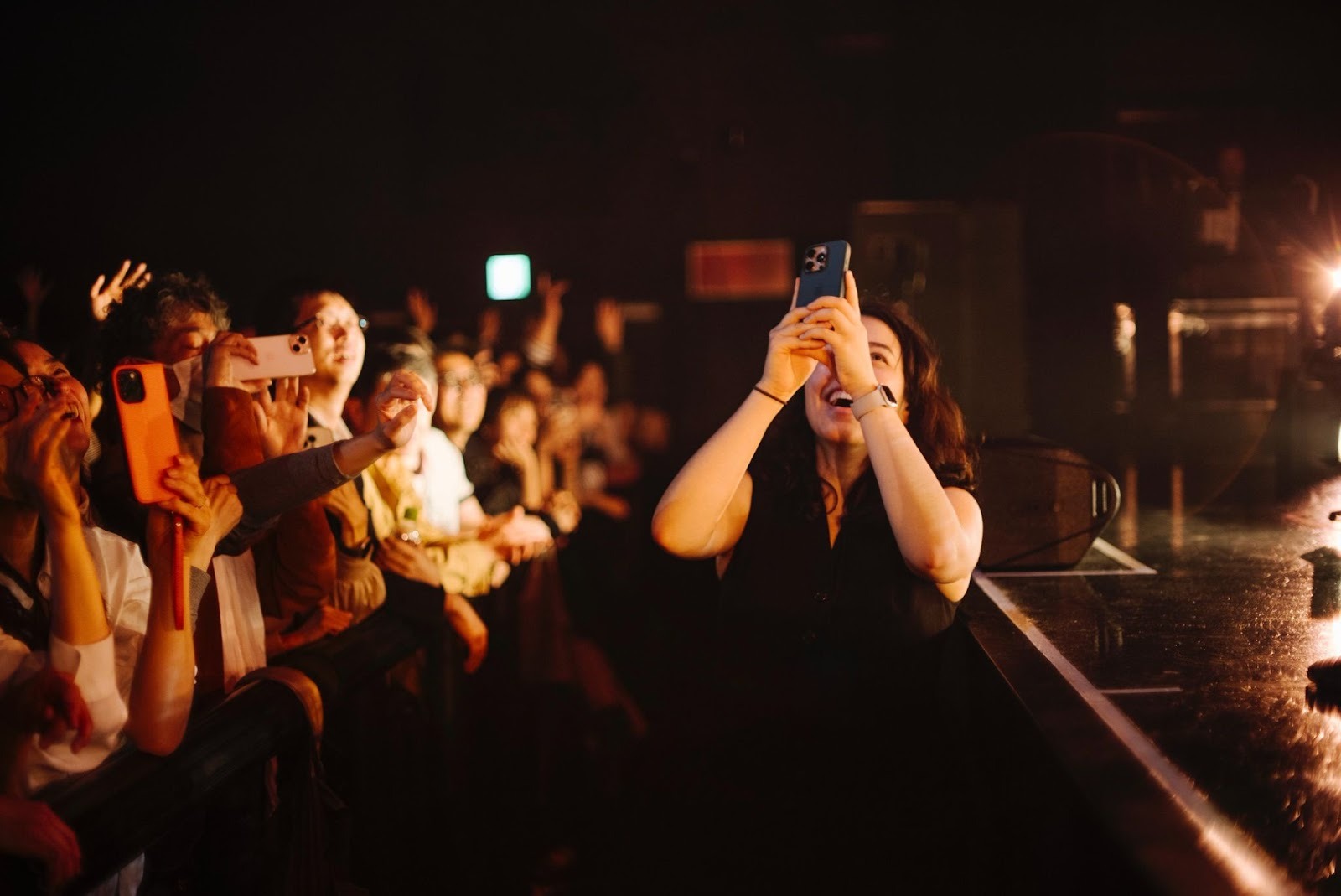
“Gen Admission taught me more than any internship ever did, and I still use those skills daily.”
LR: My biggest challenge transitioning from the touring world was the loss of routine and suddenly having a large number of people and projects to juggle. Touring is very quantifiable, you have an end date and you see the same people everyday. On my biggest tour, I was in charge of 72 crew members. But in an artist’s day-to-day life, with projects spanning from recording, touring, promo and beyond, that number multiplies by a lot. There are constantly new collaborators, teams, and moving pieces to keep track of. It honestly took me about six months to stop feeling like I was sprinting in a race I hadn’t trained for. But now, I’m honestly loving the constant change and the lack of routine. It's a good exercise for the brain and makes every week feel more exciting.
Another challenge I hadn’t foreseen was learning how to interact directly with an artist. On tour, my role was focused primarily on the crew. I interacted with artists in a hospitality capacity but not in a creative one. Being suddenly expected to contribute to conversations and sharing opinions on creative projects felt very odd. At first, even knowing what I felt or thought was difficult. Until then, I’d rarely been asked to form or voice creative opinions, so finding the right words took time. It felt a little bit like dusting off an old cabinet file in the attic. The skills were there, they just hadn’t been used for a while.
"My biggest challenge transitioning from the touring world was the loss of routine and suddenly having a large number of people and projects to juggle."
LR: In many ways, every aspect of the job has the potential to be stressful because everything feels important. I came in with the touring mentality of “if you’re on time, you’re late.”, everything is logistical and immediate. But in the artist world, especially when you’re communicating with a global audience, intention matters as much as speed.
You have to be incredibly attentive to how something feels. A video might be technically ready, but emotionally it’s not landing. In those cases, it’s better to post when the artist and the team feel it’s right and true to the mission, than to rush release something that doesn’t feel aligned. That tension between momentum and meaning can be stressful, especially when it impacts timelines with external partners or doubles work to an already packed week.
I’m lucky to work with an artist who doesn’t follow a traditional album cycle and rarely takes extended breaks, but it also means we’re constantly juggling multiple overlapping projects and priorities shifting quickly, so pressure is mostly always on. But I try to keep perspective. We’re not doctors or nurses, if something gets pushed, no one is in danger. I really had to adjust my sense of urgency (and I’m still working on it) to keep the pressure productive rather than overwhelming.
“In many ways, every aspect of the job has the potential to be stressful because everything feels important.”
LR: Never stop learning, stay interested, stay curious. Ask questions, learn new skills, and dig deeper into anything that sparks your interest. When I was a production coordinator on tour, I spent several load-ins working alongside the lighting crew. Not only did I pick up technical skills and language I still use today (like understanding different types of fixtures), but I also gained real insight into their world and workflow. It helps me communicate better, jump into conversations confidently, and most importantly to make people feel seen. You never know when a skill or a piece of knowledge will become useful, and if nothing else, it’ll teach you what you don’t enjoy and don’t want to do.
The same goes for opportunities. They might not look perfect or align with the plan you had in mind, but treat them as chances to grow. If I had said no to the day-to-day management opportunity when Marc called me simply because it wasn’t part of ‘my plan’, I would have never realized how much I missed being creative. Don’t say yes to everything, but don’t say no on principle. Trust your gut. If something doesn’t make logical sense but feels right, explore it. Sometimes things aren’t a part of the plan, but they’re there to teach you a lesson.
Care deeply, stay curious, don’t be afraid to get your hands dirty, and never think you’re above learning. The small tasks, the side conversations, and the unexpected opportunities are often the ones that shape you the most. The career you end up loving might not look like the one you planned.

LR: Needless to say, Gen Admission! Genuinely! Understanding the different roles in the industry and what people actually do is instrumental in being able to learn quickly and knowing where you yourself want to be.
But the most important resource, in my opinion, is the people you grow alongside. There’s a belief that networking has to be vertical, meeting senior executives, chasing titles, trying to be in the right rooms. Of course, that has value, but I don’t think it matters nearly as much as the people around you who share your interests, your values, and your ambition. Don’t underestimate the power of being in the gutter together (haha!).
I would not be where I am without the friends who made me feel safe enough to ask the ‘stupid’ questions, admit when I’d made a mistake, or ask for help. That kind of environment accelerates your growth more than any intimidating boardroom ever could. Some people like to frame the music industry as cutthroat, but you will move so much further if you’re warm, supportive, and human. Be a girl’s girl, or someone who always chooses collaboration over competition. Not only will you get further, you’ll also have so much more fun along the way.
If you enjoyed this article, sign up for our newsletter and follow us on Instagram and LinkedIn to stay up to date with Gen Admission 🎶
-15%20(2).jpg)
