Essay

March 11, 2026

Unsplash
Music criticism hasn’t died; it’s lost its edge and nerve. Social media has fundamentally changed celebrity culture, press, and how we consume it. A medium that once explored new music with depth and originality now caters to appeasing fans and homogenising receptions to survive; it’s a system that punishes distance and rewards participation. There are still pockets of sharp criticism, but they are increasingly peripheral to the mainstream conversation. Music criticism has been absorbed into the influencer economy it was meant to interrogate.
And it’s not just depth that has collapsed, it’s authority. The critic’s cultural authority has become socially risky. In a time where ‘gatekeeping’ is perceived as a moral failure and everyone has immediate access to music, judging becomes less an act of evaluation and more one of arrogance. The critic is no longer a mediator of taste but an intruder into personal identity; when taste is identity, disagreement becomes an attack. The notion that people’s tastes should be immune from critique undermines the very purpose of criticism itself. The result is reviews that function less as an assessment and more as a press release. The line between criticism and marketing copy has blurred to the point of invisibility; criticism performs fandom instead of evaluation.
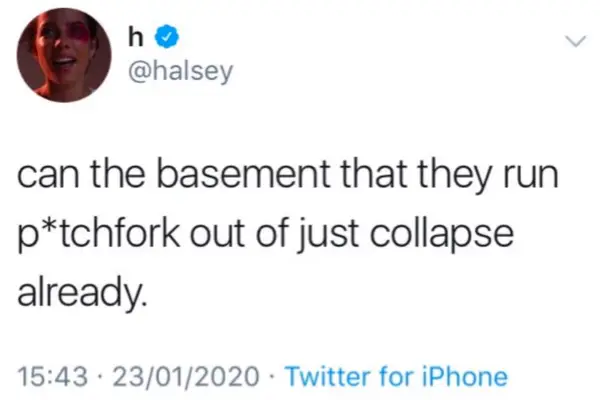
When critical engagement bucks this trend and publishes reviews that are less than adoring, they fall on the receiving end of vitriol from artists and fans alike. Just see Halsey’s tantrum over a less-than-positive Pitchfork review – a 6.5 for her 2020 album, Manic. She took to Twitter with an enviable calm to share: “can the basement that they run p*tchfork out of just collapse already.” She later deleted the tweet after realising her grave error in making an untended 9/11 reference, seeing as Pitchfork had recently moved into the World Trade Center…
Yet, this contempt is merely a symptom of a broader industry pivot. Rolling Stone skirts around facing this issue head-on, having rendered the 1 to 5 star rating redundant. They removed the star ranking system for a brief, nearly 2-year stint in 2022 before realising the error of their ways because it was ‘way too limiting’. When publications soften their evaluative language or alternate between rating systems, it signals something deeper: a recalibration toward brand safety. Criticism that risks vital relationships with and access to artists, advertisers, and fans suddenly stops making sense.
This is why the interview has come to outweigh the review. In an environment where interviews appeal to PR machines backing artists rather than critical reviews, which alienate both publication and critic from artist and fandom, they become the modus vivendi. Zane Lowe’s interview with Katy Perry for “Woman’s World” and its subsequent album 143 (2024) personifies this shift. His interview reinforces Perry’s persona and sets her up for self-gratifying comments about her commitment to the ‘feminine divine’ – something she does not reconcile with her multiple collabs with Dr Luke, whom fellow singer Kesha accused of sexual abuse in 2014; their long-running legal dispute was settled in 2023. The outcome is a shallow interview with zero engagement with audience reception. But this isn’t a failure of personality – it’s a failure of structure.
Rolling Stone has come to epitomise this new era of struggling criticism. They gave a 5-star review for Taylor Swift’s The Life of a Showgirl (2025): an album whose reception was far more divided than the review acknowledged. It was a review with an overbearing positivity that would be more at home in a pitch deck than in a critical piece. Although perhaps it is best to back down, as Taylor Swift famously penned her song ‘Mean’ (2010) in response to a scathingly negative review. And let’s be honest, being immortalised in a pop star’s diss track is hardly the average critic’s dream.
Artists aren’t losing out to this trend of journalism; journalism is. Criticism thrived in a world of scarcity. The internet has collapsed the distance between artists and fans, but criticism needs distance. Traditional criticism positioned the writer outside the artist’s brand, but contemporary criticism increasingly operates inside it – extending narrative, reinforcing persona, increasing engagement.
Historically, critics served as mediators between artists and fans, as critics and artists occupied distinct spaces. Now they share feeds, events, and audiences. But the closer critics move to artists, the harder it becomes to interrogate them. When artists and entire fanbases can engage and respond in real-time, they no longer need the critic. Artists can reach millions of followers within seconds, and fans don’t need someone to tell them new music is available and whether they should spend their money on it when that music is widely accessible and free.
Audiences have evolved faster than the industry. The current ecosystem incentivises affirmation, and so publications have toned down their criticism to achieve this; where traditional criticism offered context, evaluation and rank, modern listeners want affirmation of their identities and communities. These are vastly different emotional products.
What makes this shift so disappointing is that we’ve lost a certain style of reviews as the function of criticism has evolved. Music critics used to be independent of the artist. They used to have opinions. Critic Greil Marcus once opened his Rolling Stone article on Bob Dylan’s Self Portrait (1970) with ‘What is this shit?’. I think he would like the intro to an anonymous Paste writer’s hyperbolic review of The Tortured Poets Department: ‘Sylvia Plath did not stick her head in an oven for this!’.
Yes, it’s inflammatory, but it’s funny and opinionated, exactly what a review should be. This isn’t to say an album should never be reviewed by a fan who loves it; when genuine excitement and joy are injected into a review, it’s a joy to read, but it’s a very different experience from reading a passionate critical review that explores the opposing view and challenges the art and artist. It provides more depth to music criticism, allowing the industry to have nuance.
This shift within the industry isn’t the result of weaker critics or thinner-skinned artists but rather a fundamental structural shift. It is symptomatic of a wider media environment that has collapsed distance and made access monetisable. The critic survives, albeit in a different form; they are less an intermediary and more another participant. From major publications, they join the internet trenches of social media where anyone with a platform and an opinion are able to act as critics and the frontlines of grassroots publications fighting to keep criticism alive. Whether that evolution enriches culture or flattens it remains the more interesting question. When everyone’s a critic, is no one a critic?
Stan culture has repositioned pop stars as representatives of entire subcultures. To criticise them can feel like criticising their audience. In that environment, art begins to feel uncriticisable. If this is a transitional period for music criticism, it is one ventured into with great caution – and caution rarely produces great criticism.
If you enjoyed this article, sign up for our newsletter and follow us on Instagram and LinkedIn to stay up to date with Gen Admission 🎶