Trend Analysis
June 9, 2026
NPR
Tiny Desk concerts are a religion. They are a cultural symbol. They are revealing. They are where intimacy and talent coexist.
Annahstasia gently led her band through a deep breath. The Goo Goo Dolls made a self-deprecating joke regarding their initial applause. GIVĒON expressed disbelief that ‘it’s really a tiny desk!’ and talked about performance as a therapeutic process. Oklou stripped back her electronic, auto-tune heavy album into something entirely acoustic, bewitching and even more intimate. Kokoroko admitted to not feeling ready for Tiny Desk up until they were there in the room and their performance was magical.
Tiny Desk is intimate, personal, and allows audiences to watch their favourite artists as humans. But why do these performances often feel more emotionally resonant than huge arena shows?
For years, pop stardom was built on polish, fantasy, perfection, scale, and distance. Now, audiences increasingly reward emotional fluency, visible vulnerability, conversational performance, and intimacy. Tiny Desk has become symbolic of that shift as it allows for proximity.
Some of music’s most successful artists right now often sound less like stars and more like emotionally articulate friends. It’s a balancing act of celebrity being relatable enough to feel human but exceptional enough to retain some distance and stardom. We’ve replaced the aspiration fantasy of pop stardom with the companionship fantasy. A symptom of this is the success of ‘girlfriend music’ – artists like Gracie Abrams, Olivia Rodrigo, Phoebe Bridgers, and Clairo to name a few who reflect this ‘genre’ – which isn’t just about relatability but emotional articulation.
‘Girlfriend music’ is the kind of music by female artists that’s confessional in a way that feels like the conversations you have with only your closest friends. It seamlessly and imperceptibly intersects branding, femininity, and psychology. The almost-whispered delivery that a lot of these artists favour amplifies the vulnerability and intimacy that attracts people, but it goes deeper than that into lyrics that are often emotionally intricate and fluent. These artists narrate feelings in real time, sounding conversational and avoiding a diva-like distance (something that might define the iconicism of Mariah Carey’s ‘Obsessed’). They articulate feelings that audiences often struggle to put into words alone. They become emotional translators; in a culture that values therapy now more than ever, that is valuable. Their music invites identification rather than aspiration, which is something Tiny Desk performances often achieve.
Clairo’s ‘Bubble Gum’ is achingly vulnerable. Her lyrics – ‘I'd do anything for you/ But would you do that for me too?’ – articulate something that everyone has felt at least once. They’re relatable both romantically and platonically. The style of much of her wider lyricism feels like speaking something you’d only really admit to yourself or close friends about a situation.
Gracie Abrams’ ‘That’s So True’ is brutally honest in its account of a messy breakup. It went viral because of how relatable and accessible it was to listeners. Abrams creates a ‘friendship’ energy with her audience, especially through the self-awareness and vulnerability in her songs.
Phoebe Bridgers’ listeners become her confidants; she shares her ghosts with the listener through her confessional lyricism, paired with her whispered vocal delivery. Hers is a very specific type of sadness that resonates because of its specificity.
‘I have emotional motion sickness
Somebody roll the windows down
There are no words in the English language
I could scream to drown you out.’ (‘Motion Sickness’)
When she sang this song on Tiny Desk, she bashfully introduced it by saying, “This song is about being in love with someone who’s super mean to you. I don’t know if that’s relatable, you know, like, conflicting feelings. Don’t know if that’s relatable at all.” And yet, with over half a billion streams, I think an entire fanbase might disagree. It is completely relatable.
Good music is revealing of the human condition, and that’s what these artists achieve in so many of their songs. These artists of ‘intimate pop’ – or even ‘girlfriend music’ – contrast the hyper-polished pop stardom that dominated the 2010s. They succeed not by feeling aspirational or untouchable, but emotionally legible; rawness now carries cultural value.
Across so many other cultural cornerstones, we’re seeing a growing demand for access to stars, from conversational internet culture to parasocial intimacy. We’ve had a death of mystique; in the 2010s, audiences wanted to become their favourite stars, in the 2020s, they want to understand them. It’s why podcasts like Therapuss with Jake Shane and Call Her Daddy with Alex Cooper, low production and deliberately ‘informal’ video styles, and creators like Brittany Broski and Madeline Argy – among other forms of perceived authenticity online – have found success. Proximity is the dominant aesthetic online right now.
Digital fatigue is increasingly seeing audiences pull away from flawlessness – we crave authenticity, reality, imperfection, intimacy. The irony is that intimacy is becoming a kind of performance itself. Tiny Desk’s cramped office setting sets artists up for casual conversations and visible imperfections in a way that feels authentic but is still curated. What matters isn’t whether that intimacy is real, though, but that audiences are increasingly valuing that feeling of intimacy over spectacle.
In a post-pandemic culture, this shift to demanding intimacy feels almost inevitable. For years, audiences consumed content from bedrooms, kitchens, and webcams; the polished studio lost its allure. Distance collapsed and audiences aren’t clamoring for it back.
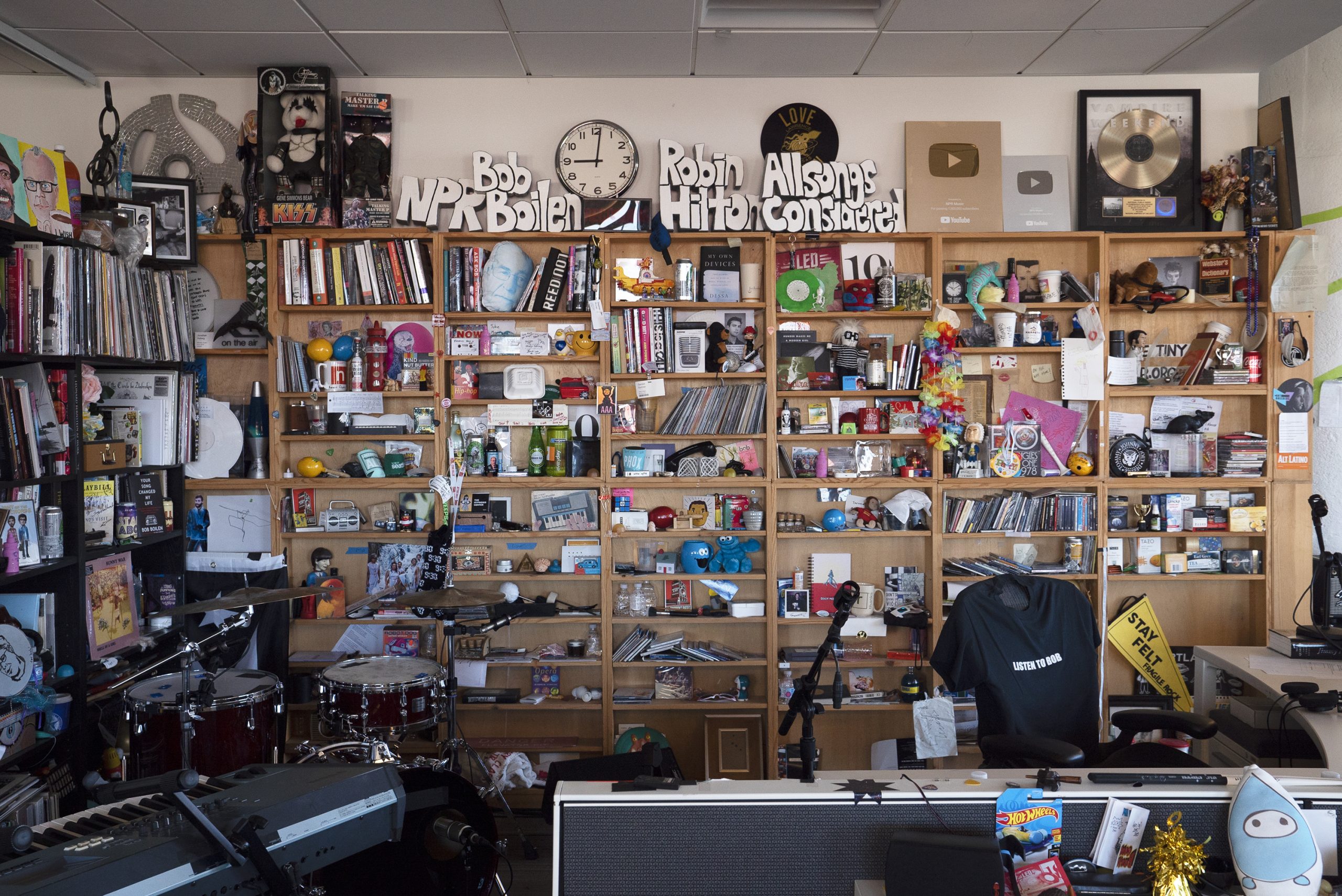
Tiny Desk has become symbolic of this broader cultural shift away from spectacle. It visually reinforces this growing expectation that artists should be emotionally accessible. The cramped set, the visible imperfections, the casualness, and the stripped-back production; it allows the audience to feel. It allows them to be emotionally adjacent to artists. Tiny Desk’s entire aesthetic contradicts traditional pop grandeur. It functions as a ritual of demystification. Tiny Desk audiences aren’t asking if artists can sing, but rather who they are behind studio production.
Live performances like these that are smaller, softer, and more intimate, feel more emotionally accessible because of the visible eye contact, relaxed conversation, stripped arrangements, and visible imperfections. There’s a closeness that the audience is invited into – almost like it’s a one-on-one performance. You connect more deeply and more easily than in a crowd, where connection tends to be more communal than personal. The artists become close enough to understand. Watching artists perform songs the audiences are already familiar with moves the listening experience from consumption to something closer to observation. They watch their favourite artist inhabit a song.
Dua Lipa’s Tiny Desk (Home) Concert is the channel’s most-watched video with 148M views which at first feels surprising because she has a very polished, grandiose pop persona. Tiny Desk has had so many other artists that fit more seamlessly into an acoustic or lo-fi performance structure and yet it was Dua Lipa’s stripped-back performance of her songs that resonated so much. Her performance highlighted that the demand for intimacy isn’t genre specific but a cultural specificity. A stand-out is her ‘Love Again’ rendition which was a slower, less production-heavy arrangement – it allowed the song to become even more intimate and emotional, hitting you harder than the disco-pop studio version.
It’s not just Tiny Desk. There are multiple other platforms that do this too, such as BBC Live Lounge, Triple J, Mahogany Sessions, COLORSxSTUDIO, and so many more. These live sessions remove the distance traditionally associated with pop stardom. Tiny Desk doesn’t just showcase songs differently; it reframes artists as emotionally available people rather than unreachable celebrities.
The success of Tiny Desk is indicative of growing audience desire for proximity over perfection. There is a market for seeing GIVĒON’s spontaneous surprise in the middle of a set, for the (unfounded) insecurity of Kokoroko, for the moments when a pop star stops feeling like a pop star and starts feeling like a person. We still admire talent, charisma and stardom, but we also want access. We want to see the joke between bandmates, the nervous introduction, the forgotten lyric, the deep breath before the first note. Tiny Desk hasn't created this cultural shift so much as become its clearest symbol. In an era defined by emotional fluency and parasocial intimacy, and the collapse of celebrity mystique, the most revealing stage in music might just be a cramped office behind a desk.
If you enjoyed this article, sign up for our newsletter and follow us on Instagram and LinkedIn to stay up to date with Gen Admission 🎶

.png)