
Artist Development

April 30, 2026
Sony Music
In October 2024, Gracie Abrams released the deluxe edition of her sophomore album, The Secret of Us, featuring the track that subsequently became her first UK Number One single, ‘That’s So True’. The release was followed by a series of live performances of the song where Gracie sang the hit, accompanied by an unfamiliar face who provided harmonies for a stripped-down, acoustic version. As clips of the various performances began to circulate on social media, the internet waded in with characteristically negative opinions, this time directed towards Gracie’s duet partner.
While many viewers erroneously assumed that she was a fan who had been lucky enough to be invited on stage, others were more scathing in their review. The comment section from the video shared by Spotify’s official TikTok page of the two performing is home to harsh remarks with watchers asking, ‘why is she always there?’ and ‘is this a parody?’ - one commenter even stated that while they appreciated the effort, Gracie needed to leave her vocal counterpart ‘on the bus’ from now on. Little did they know, the woman singing alongside Gracie was her childhood best friend, collaborator and co-writer of ‘That’s So True’, Audrey Hobert.
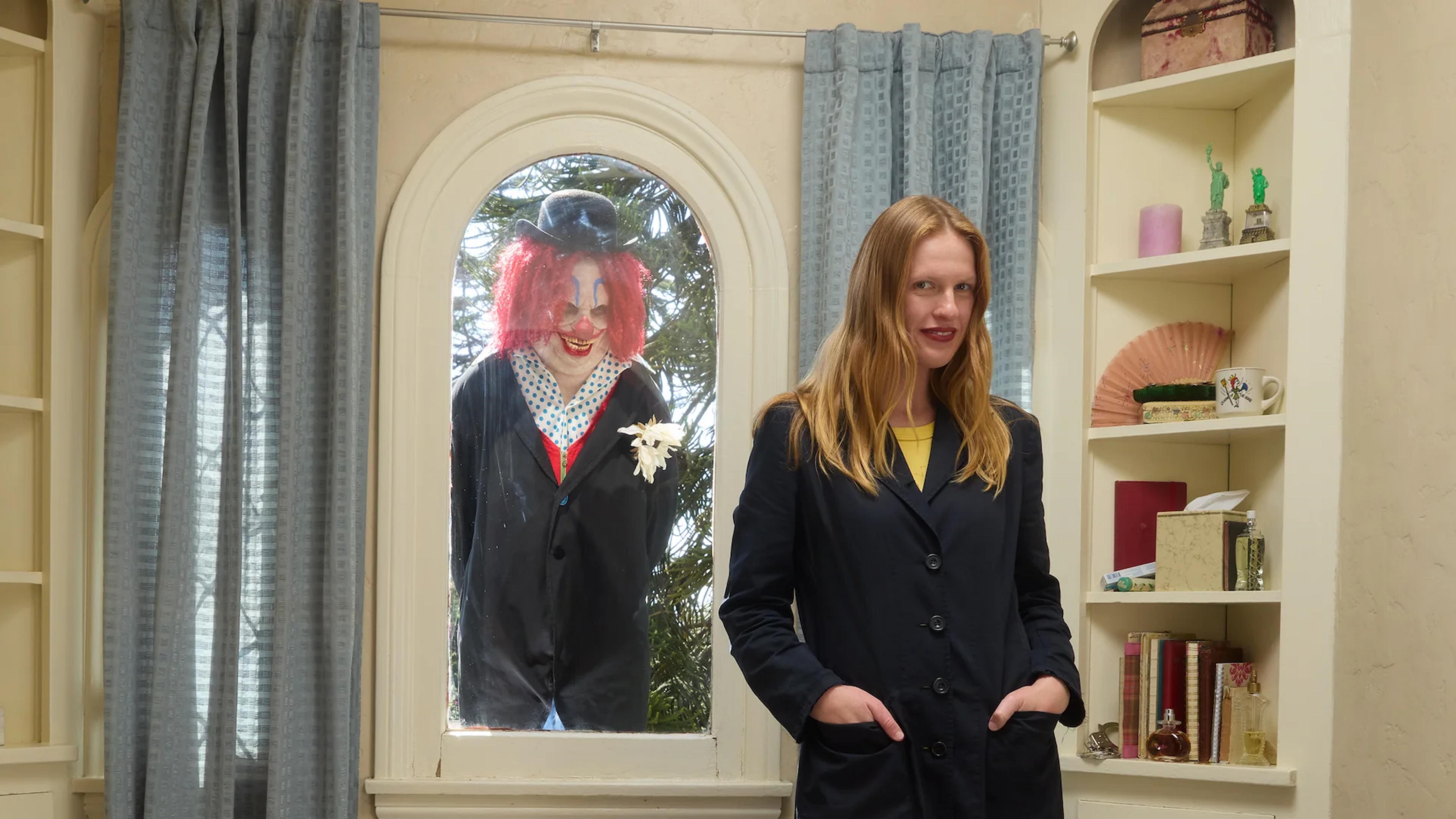
Since her frosty reception, Audrey has gone on to release her debut album Who’s the Clown? which, despite initial reservations about her character, received an overwhelmingly positive response, triggering the growth of her own loyal fanbase. This seems incongruent with the fact that, not long ago, one of the most popular searches associated with the burgeoning artist on TikTok was ‘what’s wrong with Audrey Hobert?’.
On Who’s the Clown?, Audrey willingly offers herself up as Gen Z’s court jester and discloses the intricate details of her deepest insecurities, dating life, and shares the general struggle that comes with being a woman trudging through the cloddy terrain of her 20s.
Her verbose lyrics often feel more akin to the chaotic musings you might come across in someone’s journal rather than songwriting, but that is precisely what makes her so charming. In fact, whatever is ‘wrong’ with Audrey is exactly what might be wrong with a lot of us; we just don’t want to admit it.
Plenty of artists have crooned over unrequited love or failed relationships - topics which are, no doubt, experiences that many can empathise with. However, in her songs, Audrey takes these motifs and fires them back at us in a direct and confronting manner. On her track ‘Thirst Trap’, she pines over a boy who clearly doesn’t reciprocate her affection, and she recounts how she “[listens to her] playlist and [pretends she’s him],” “[looks at what she posts] and then [pretends she’s him].” At risk of exposing myself, I must admit that, upon hearing these lyrics for the first time, I felt a slight chill down my spine as I thought, ‘how does she know?’
When playing around with perspective and attempting to view oneself through the eyes of a nebulous third party, it is easy to find oneself consciously changing their behaviour; listening to music, wearing clothes, reading books that, if on the off chance one is being watched, (think Love Island meets The Truman Show) will surely make the onlooker think: ‘Wow, they’re cool’. Ironically, doing things to appear cool is, unsurprisingly, not very cool. I’ve taken part in this Orwellian role play once or twice; going about my business in my bedroom, all the while imagining that someone is watching me, zooming in on my hands, impressed as I take my phone, pause for a second, and knowingly put Radiohead on shuffle; if you look close enough, you can almost see me wink. Though I had originally thought this behaviour to be idiosyncratic to my personality, from listening to Audrey’s music, I now know there is at least one other person in the world who has also played this role, foolish as the act may be.
Under the guise of guitars, synths, and indie-pop honesty, Audrey uses one hand to prod at our embarrassment and with the other, she gently pushes us to embrace some uncomfortable truths. On ‘Shooting Star’, she reveals, “when I’m drunk at the club I want to be felt up.” Meanwhile, on the anthemic ‘Sue Me’, her habit of confessional outbursts culminates in the refrain, “sue me, I want to be wanted.” Again, these admissions feel deeply personal, if not controversial - it’s risqué to hear Audrey proclaim that after a few glasses of wine, she’s keen for a hookup. However, we know she isn’t the only one.
We see it all the time - strangers colliding on the dancefloor each weekend, kissing and touching one another with the intimacy of a couple who have known each other for years. Oftentimes, what belies these flirtations is a demand for connection and a desire to feel wanted, needs that seem palatable only once inhibitions have been lowered, alcohol excusing lust and passion as they nudge their way through watertight boundaries built upon humility and awkwardness. When Audrey lays out her wishes so prosaically in ‘Shooting Star’s’ opening lines, she makes it all seem rather matter of fact. In one moment, the line feels targeted: I see you, it says, I see what you want. However, in the next, it feels comforting: I see you, it says, I see what you want, and that’s okay. Audrey’s ability to empathise with these niche experiences and her choice to recount them so brazenly helps listeners move away from shame towards embracing (dare I say, celebrating?) these quirks, guided by someone who really gets it.
The stock price of relatability is high right now - thanks to the exponential growth of TikTok in recent years, the fourth wall between fan and artist has been eroded in parts as celebrities have taken to the app as a way of interacting with fans on a more personal and even playing field (see: Zara Larsson sharing a video of herself from her hotel bed in Amsterdam, admitting that she’s a bit giggly, ‘if you know what I mean’). In these uploads, stars have forgone the studio lights and camera crews and opted instead for videos recorded on their iPhones under dull bedroom lighting, making them feel more like FaceTime calls rather than strategic content. All of this is done in the hopes that celebrities can show their fans, ‘See, I’m just like you!’.
These backstage supercuts of day-to-day celebrity existence, though, can easily be revealed to be a facsimile of ‘normal life’. There are clues in these otherwise unassuming clips that indicate to viewers that the divide between fan and artist is still ever-wide even when it has been blurred; does a Zara Larsson TikTok still feel relatable when you notice that she’s wearing True Religion jeans? It’s these subtleties that narrow the parameters of relatability and perhaps stop fans from feeling that these artists truly know what they have experienced.
In a self-deprecating disclosure on her track ‘Phoebe’, Audrey sings “why else would you want me, I think I’ve got a fucked up face.” She’s not the first artist to express dislike towards their appearance. Although, glossing over Audrey’s Instagram and seeing repeated shots of her without make-up, donning her pale skin and straight ginger hair with clothes that look fresh out of M&S circa 2004, it’s understandable why she might feel insecure. She looks remarkably normal. Her long limbs often shrouded by a trench coat, she stands awkwardly, not quite smiling, but smirking in a way that is a little disconcerting. This is a far cry from the designer labels and Nina Park-painted faces that are usually centre-stage at celebrity functions. When seeing Audrey and thinking about the lyrics she writes, the puzzle finally comes together: these are the stories of a girl who truly grew up feeling like the odd one out, because she is. Forget ‘girl next door’, she’s the girl you sat next to in Maths and then went to drama club with (note: having passions and interests when you’re a teenager is not cool).
Audrey’s music transcends ‘relatability’. It even surpasses resonance. She has succeeded in cultivating a bond of trust with her fanbase that is founded in shared experience. In the same way that we cringe when we watch back a video of our younger selves, metal braces protruding from our mouths and teenage acne erupting on our foreheads, Audrey demands that we acknowledge the times where, as adults, we’ve behaved embarrassingly and makes us unexpectedly tend to our most awkward moments. That being said, she’s right beside us the whole time. After successfully pushing us to embrace the uncomfortable, Audrey’s hand is free to hold our own, guiding us through a rocky path and helping us to have fun on the way. When Audrey jumps, we jump too, legs in the air, sprawled out at jaunty angles in true Hobert style. What’s wrong with Audrey Hobert? Who could really say - but I love it.
If you enjoyed this article, sign up for our newsletter and follow us on Instagram and LinkedIn to stay up to date with Gen Admission 🎶

.jpg)
%20(1).png)