Artist Development
November 20, 2026
Daisy Chain Fields festival
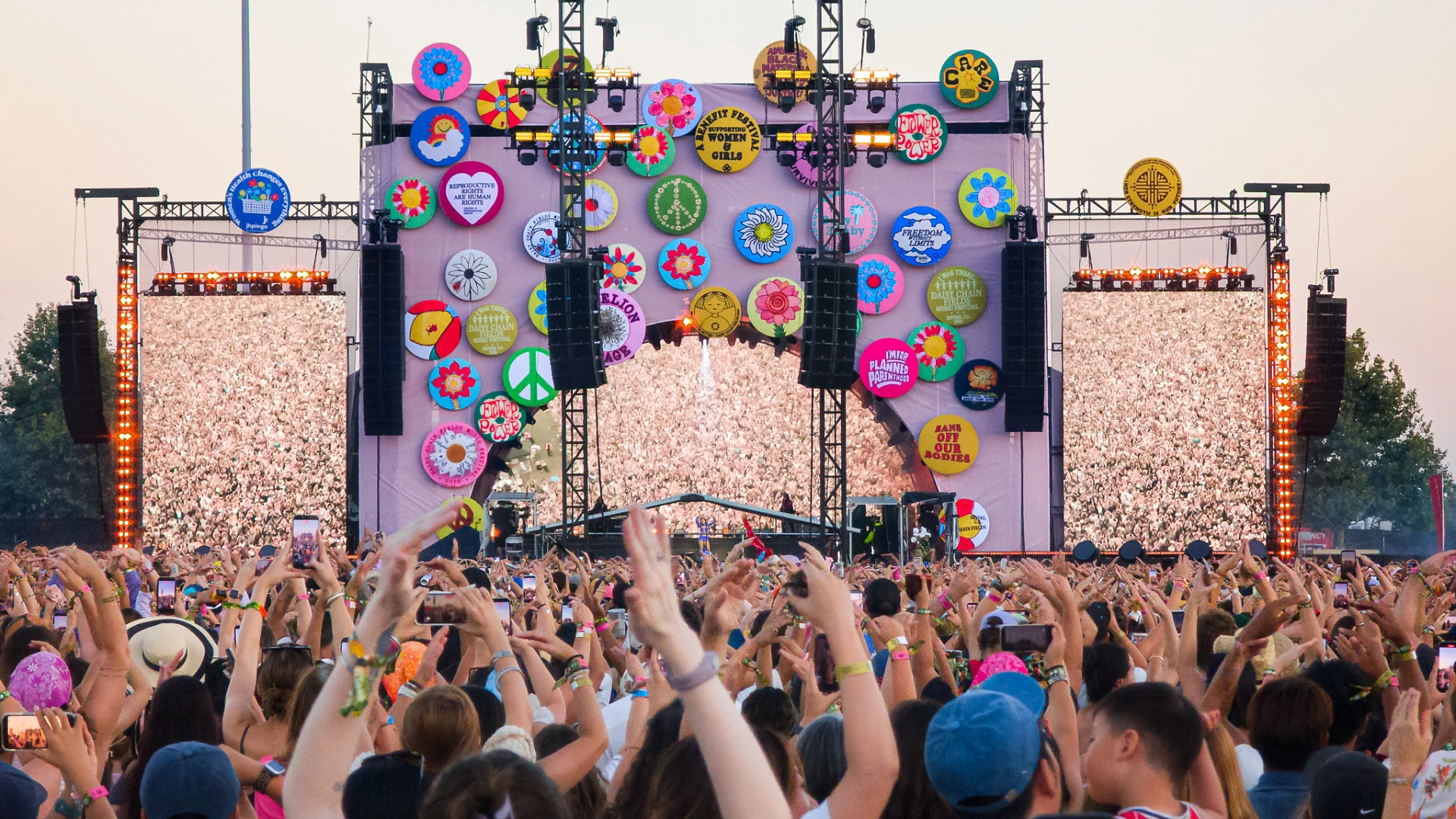
In June 2026, Olivia Rodrigo announced the inaugural Daisy Chain Fields Festival, accompanied by an all-star, all-female lineup. The festival took place at Great Park in Irvine, California on August 29th 2026, welcoming a sold-out crowd of over 45,000 people.
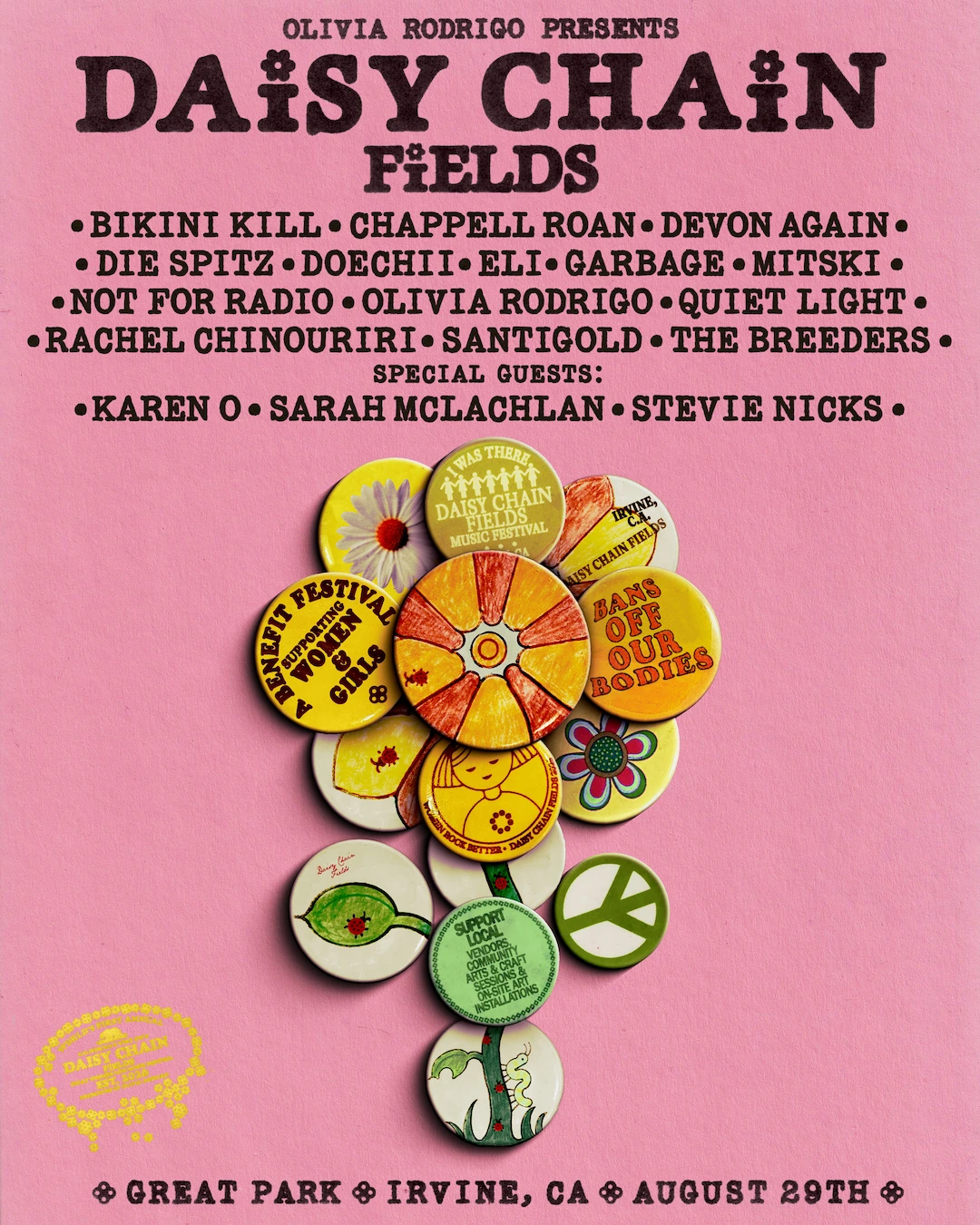
Olivia selected her favourite artists for the bill, including Riot grrrl legends Bikini Kill, Chappell Roan, Die Spitz, Eli, Rachel Chinouriri, and Santigold. Every participating artist agreed to play for free, donating their fee to one of the festival’s ten non-profit partners, all centred around women’s rights.
The lineup became even more impressive with three special guests: Stevie Nicks, Alanis Morrisette, and Sarah McLachlan, who each performed with Olivia during her set.
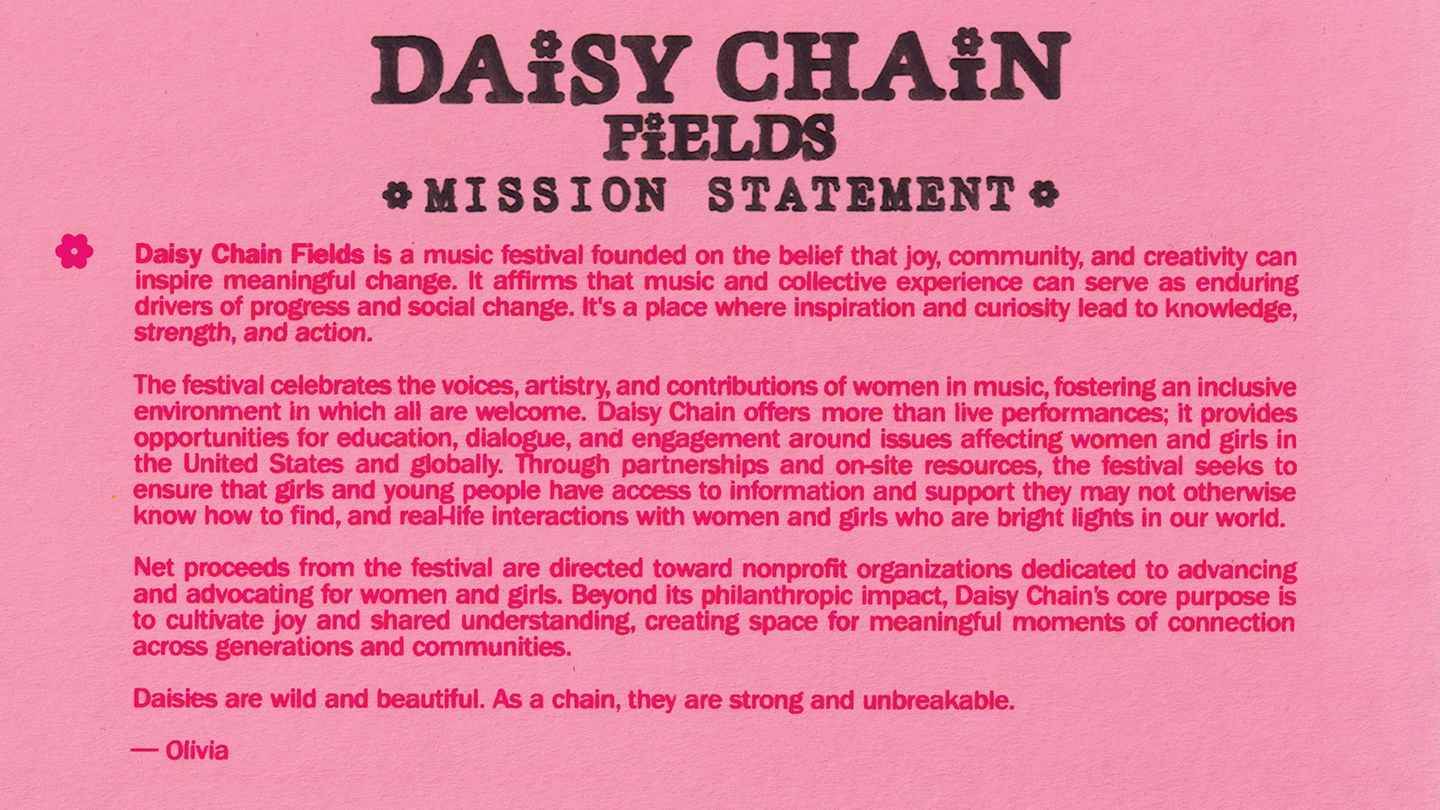
Olivia described her vision for this festival as girls sitting underneath a tree, making [daisy chain] flower crowns or friendship bracelets. Daisies became the perfect symbol for this vision: individual flowers can be woven together to create a chain that is larger than any one person, yet surprisingly strong. The daisy-chain metaphor materialised before the first note was played. Olivia inherited the idea of an all-women’s festival from Sarah McLachlan, whose Lilith Fair had provided the blueprint nearly three decades earlier. It was very fitting for Sarah to open the inaugural festival, creating a literal link between the two.
Sarah McLachlan performed alongside Olivia, including a rendition of her song ‘Angel,’ in tribute to the late Dolly Parton, another female artist who dedicated their career to activism and philanthropy. This poignant moment captured one of Daisy Chain Fields’ central ideas: that the values, influence and experiences of women don’t have to exist in isolation, but can be passed from one generation to the next. Olivia later closed the festival with a performance of ‘Landslide’ with Stevie Nicks and slipped in a “See you next year,” conveying her wish to turn the festival into an annual event.
For Olivia, community is not just about bringing 45,000 people together for one day. Community is imperative for women, particularly at a time when those seeking to undermine women's rights can benefit from women feeling isolated and overwhelmed. Her hope was that girls would leave the festival feeling seen, validated and with a renewed sense of possibility after seeing the work being done by other women, including feeling empowered to contribute themselves.
That ethos extended far beyond the festival walls, however. Leading up to the festival, Olivia launched the “Daisy Chain Reaction Volunteer Drive” in partnership with L.A. Works. To have a chance at winning one of 125 pairs of giveaway tickets to Daisy Chain Fields Festival, volunteers needed to sign up to the non-profit organisation and provide a collective 1,000 hours of volunteer work between July 22nd and August 20th. The Livies quickly smashed that target. The initiative offered another literal interpretation of the daisy-chain metaphor: individual contributions snowballing and becoming considerably more impactful together.
From the outset, Olivia stated that 100% of the net proceeds will be going to various charities and organisations. On the eve of Daisy Chain Fields, she announced a staggering $10M had been raised for ten chosen charities. Extraordinarily, Melinda French Gates announced on stage that she would match their fundraising efforts, bringing the total proceeds to $20M.
Yet, the most significant link in the chain was arguably the one connecting Daisy Chain Fields to the festival that inspired it. The first person Olivia called when planning this festival was Canadian artist Sarah McLachlan, the co-founder of an all-female travelling music festival in ‘97 named Lilith Fair.
Lilith Fair was created in 1996 in response to the music industry at the time, with the aim of challenging the lack of female representation in live music and radio.
Thirty years later, Daisy Chain Fields shares many of its defining characteristics with Lilith Fair: both were founded by socially-conscious female artists, featuring all-female line-ups, and both used music as a vehicle for a wider social purpose. However, the similarities only make the differences far more striking.
Sarah founded the Lilith Fair tour to challenge the industry’s assumptions about who belonged on a festival stage, and to showcase and celebrate the abundance of talented female artists at the time.
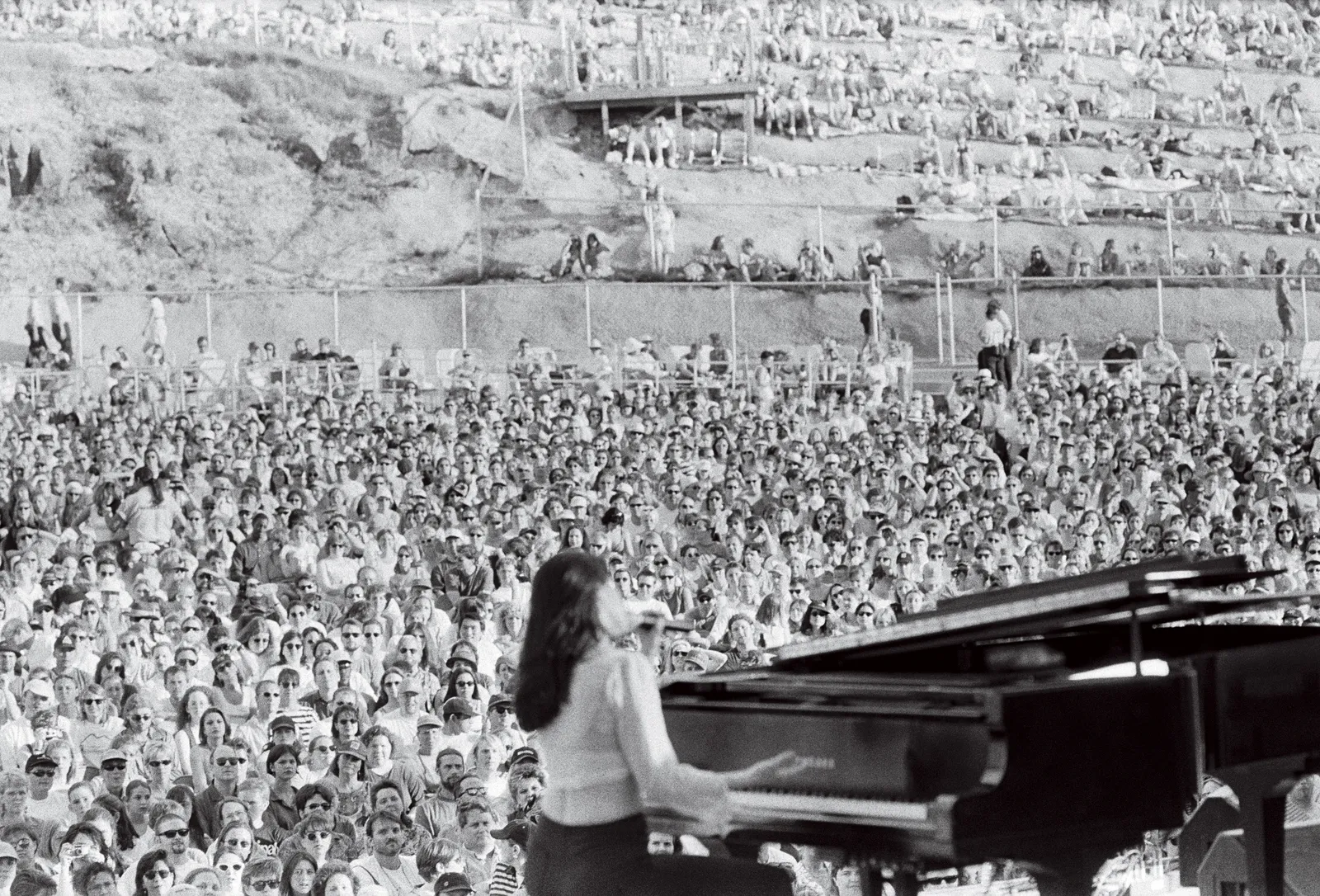
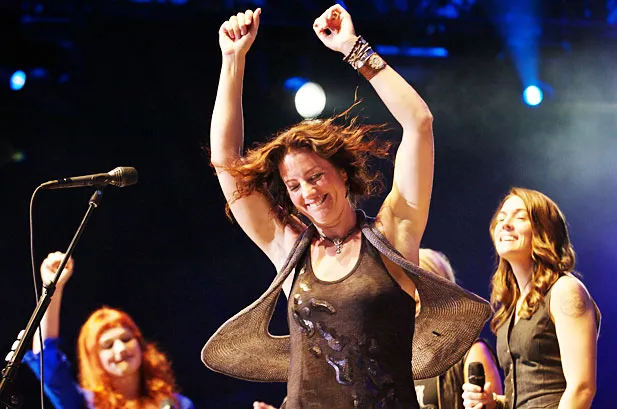
During the summers of ‘97 to ‘99, Lilith Fair played 135 shows to two million people across and featured an incredible female line up including: Suzanne Vega, Sheryl Crow, Tracy Chapman,, Fiona Apple, Joan Osborne, and The Cardigans.
Lilith Fair grossed $16m in its first year making it the highest grossing festival tour of the year. Its commercial success directly challenged the industry's justification for excluding women: female artists were commercially viable, and audiences would show up for them. After a 3 year run, it raised over $10m for charities such as local women’s shelters, breast cancer funds, HIV/AIDS prevention, and planned parenthood.
Despite huge progress since Lilith Fair, Daisy Chain Fields is anything but a nostalgic recreation, but rather a more urgent response to the changing US political landscape
Lilith Fair initially came about as a response to female exclusion in cultural spaces: festival lineups and radio play. Statistically speaking, female representation in cultural spaces has dramatically improved since 1997, as discussed further on our blog here: Women Are Headlining.
Increased female visibility however, has not translated into more secure rights. If Lilith Fair’s message could be distilled to if the industry won't create space for women, we will create it ourselves, Daisy Chain Fields takes that idea a step further. Olivia is not simply creating space for women to perform; she is using that space to direct attention, money and collective action towards furthering women's rights.
During a time when women’s rights are regressing around the world, Daisy Chain Fields aims to bring people together to advocate for women’s rights through a shared love of music. Its aim is to create a safe space where women can be seen and supported.
Daisy Chain Fields inherits a cultural space vastly different from where Lilith Fair left it. There is a striking contradiction to be seen in American women’s place in society in 2026 compared to 1997. Since the Supreme Court overturned Roe v. Wade in 2022, there is no longer a federal constitutional right to abortion before viability, a regression that would have seemed unimaginable to punters at Lilith Fair.
For Olivia, her memory of Roe v. Wade being overturned is closely linked with her first festival experience: Glastonbury 2022 when she brought out Lily Allen to sing ‘F*ck You,’ dedicating the song to the five supreme court justices who voted against abortion rights. It was a bold statement for a 19 year old to make at her festival debut, stating “I’m devastated and terrified that so many women and so many girls are going to die because of this.”
The Daisy Chain Fields festival has been established during a year where women’s cultural impact and prevalence is undisputed, yet their fundamental bodily rights have been proven to be fickle and debatable. The political urgency is therefore not incidental to Daisy Chain Fields, it’s part of its architecture.
Olivia’s comprehensive approach to furthering reproductive rights is broader than the question of abortion access alone. The $20 million raised will go towards ten charitable organisations that fight for women’s rights over the following topics: reproductive control, safe pregnancy and motherhood, escaping domestic violence, financial freedom, accessible healthcare, and dignified employment.
The inclusion of maternal health organisations is particularly pertinent. Bodily autonomy isn’t the only area where women’s rights have regressed. A woman’s right to have a safe pregnancy has also declined. CDC data illustrates that US pregnancy-related mortality has increased since Lilith Fair (rising from 12.9 deaths per 100,000 live births in 1997 to 18.4 deaths per 100,000 live births in 2024).
The CDC also reports substantial racial disparities in maternal mortality: in 2024, the maternal mortality rate for black women was 44.8 deaths per 100,000 live births, compared with 14.2 for white women. Olivia intentionally chose to support charities whose work specifically aims to improve maternal healthcare for black women (Black Mamas Matter Alliance) and indigenous women (Johns Hopkins Center for Indigenous Health) in the US.
Mothers in abusive relationships can be deterred from leaving due to financial dependency on their partner, often as a result of the lack of economic support in the US for mothers. Restricting abortion access has amplified this issue. This is why Olivia choosing the charity Free From is highly important. Their work helps survivors of domestic and gender based violence achieve financial independence and safety so they can leave those situations for good.
Olivia is funding organisations whose work aims to create structural change in the US by using litigation, law and policy advocacy to protect and expand reproductive rights.
Olivia has been a long-term supporter of female issues, as illustrated in her Fund 4 Good which raised $2m for charity through her GUTS tour proceeds. Daisy Chain Fields represents an expansion of that model: rather than philanthropy sitting alongside the music, the two are deliberately intertwined. Olivia is undoubtedly carrying the torch lit at the inaugural Lilith Fair, to confront a vastly different set of challenges.
These philosophies also extend to Olivia’s music, with her recent standalone single ‘Serena Joy’ touching on the same political themes as the festival.
The song takes its name from Serena Joy, a character in Margaret Atwood's The Handmaid’s Tale, a dystopian drama in which women's reproductive freedom is systematically controlled.
Surprisingly, this song isn’t solely directed at male counterparts or the institutions at large, it is also directed at women who passively stand by in complicity. She calls out the hypocrisy and complicity of women who uphold the same system that oppresses them. It ties in with her overall ethos: Women aren’t free until all women are free. Collective progress depends on women recognising how interconnected their freedoms are and using their individual influence to expand them for others.
Lilith Fair proved women deserve space on stage, and 30 years later, Daisy Chain Fields has inherited that space and asked what can be done with it. Olivia turned her cultural influence into a tool to advocate further for female issues, via political advocacy, financial support, and collective action. The Daisy Chain began long before the gates opened.. It became a chain of influence and inspiration moving in both directions: from one generation to the next, and from the artists who inspired Olivia to the young women now watching her.
As Melinda Gates adeptly put "long after the lights go down from this festival, the organizations doing this work will keep doing it because you all are here. So thank you for being here and thank you, Olivia." The lights have now gone down. The chain, however, remains. Its legacy will not be measured solely by the 45,000 people who gathered in Irvine, but by what continues beyond the festival.
If you enjoyed this article, sign up for our newsletter and follow us on Instagram and LinkedIn to stay up to date with Gen Admission 🎶