
Essay
May 10, 2026
Ruslan Zaplatin
Recently online, particularly on TikTok, there’s been an influx of content criticising upcoming artists for various reasons. If it wasn’t people hating on support acts because they didn’t know them or didn’t like their music, it was people criticising upcoming artists for promoting their songs by posting multiple videos about it.
Seeing almost the same video about the same track over and over can become a bit repetitive. But what these people have failed to remember or even realise is why this tends to be a common method for upcoming or, more accurately, independent artists.
For someone who is lucky enough to be signed to a record label, the job of promoting their music is largely taken out of their hands. While many artists will still manage their own social media platforms, announcing new singles or albums is often a team job. People are helping them choose when to announce, how to announce, and more. Not only that, but with a record label, the budget for a promotional cycle is going to be much higher. This means that posting video after video about it becomes less necessary, as they have other means of promotion available to them. For independent artists who are funding their career themselves, posting on social media is a free, easy way to get their music out there.
It seems that many have underestimated the job of an independent artist, dismissing it as a creative, self-indulgent and even easy career path. But, their work involves so much more than just writing and recording songs; being an independent artist also means doing the jobs of multiple people.
“When you’re independent, you're effectively your own manager, booking agent, accountant, graphic designer and content creator, alongside the performing and songwriting,” says independent artist Daisy Peacock, who was gracious enough to share her experience.
“It definitely entails much more admin than people might imagine! For every gig I played, there will be 50 others I emailed about/applied for and didn't get, and then once I get one, I have to organise band rehearsals, setlists, tech specs, promotion, transport, invoicing, etc! And then for releasing music I'll be organising social media promo, cover artwork, interviews, live streams, video content, making the press release, sending out to blogs and radio, then there's other things like making and selling merch, outfits for shows, applying for workshops and funding opportunities...and trying to maintain somewhat of a social life.”
If operating like an entire team themselves isn’t enough, with no label behind them for financial backing, independent artists are forced to cover all costs themselves. This means paying for everything from recording and publishing costs to touring and merchandise costs. For touring especially, there are so many aspects to consider.
“I put on my headline fully independently without the help/funding from a promoter, but it definitely wasn’t a solo effort, and I had incredible support from friends and connections that helped me make it happen for as low a cost as possible,” says Daisy, who broke down the total cost of her headline show for us.
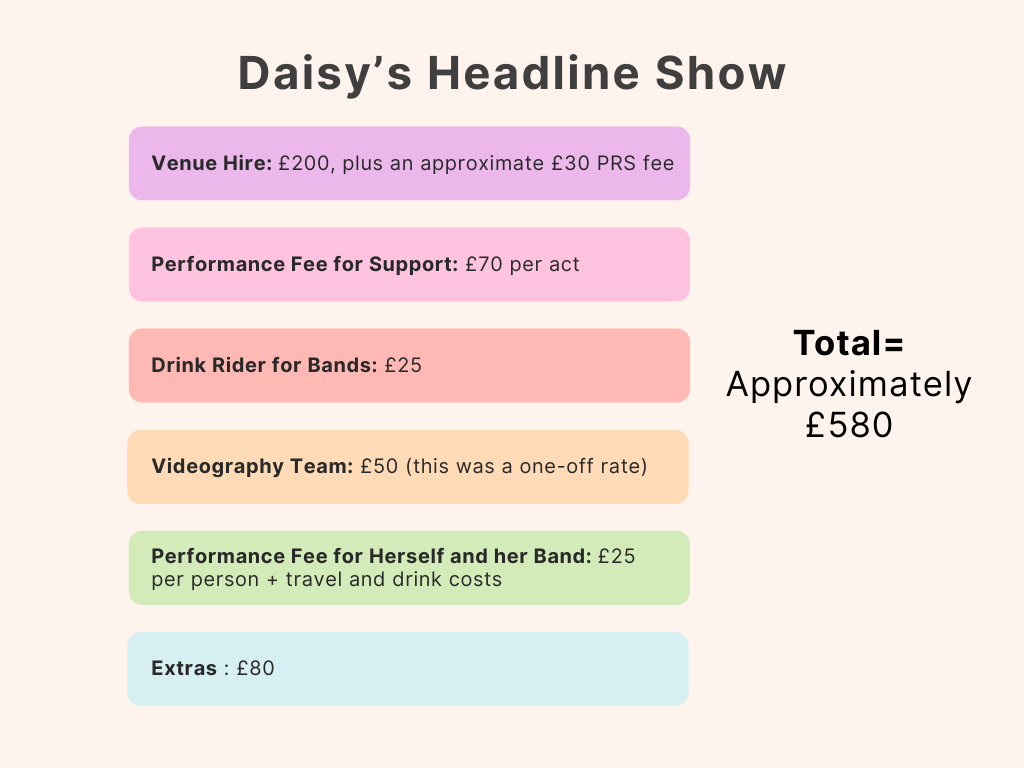
This £580 total doesn’t include the £700 she had to spend on new merchandise either. Daisy is lucky to call her bandmates her close friends, who all live in the same city as the venue, and understand that she can’t afford to pay them industry-standard musician rates just yet. For another independent artist, whose band members may be situated further away, or not so willing to take a lower pay, their costs will be even higher.
For a support slot, however, things look a bit different.
“Everything is organised for you, so all you need to do is show up and play. The main cost here is transport, which is often via train. I cover my band's travel costs, and then we share any performance fee equally.”
With support fees usually within the range of £50-100, small artists are usually losing money on these gigs, having to pay for travel and accommodation for venues further afield.
“Selling items at the merch table is normally the only way I’ll break even for a support gig, especially if I’ve brought the band.”
These support slots are so important for upcoming artists, as whilst the financial gain is minimal and not guaranteed, they do bring exposure and experience. Think of how many times you’ve seen a support act that you have liked, and gone on to become a fan; that kind of impact and connection to an audience is invaluable. And when you see a support act that maybe just doesn’t click for you, it’s worth remembering the hard work they are likely putting into their career already and to think twice before jumping online to disparage them.
Being an independent artist is hard, but it has its perks too.
“I love the freedom and sense of achievement it gives me. Every decision I make is all me, and fully intentional and thought out. I’m grateful to get to release exactly what music I want, when I want to, with full creative control of the music and the world surrounding it,” says Daisy.
Many well-established artists even decide to make the switch back to independence after years in the industry. Where before they may have been restricted to certain choices or contracted to releasing a certain number of albums within a given time period, going independent with an already secure fanbase grants them that freedom over their creative expression.
Lorde is one recent example, splitting from Universal Music Group’s Republic Records after signing when she was just 12 years old. “I have been in that contract for a very, very long time, in some form of that contract since I was 12 years old, when I signed my first development deal with Universal”, she said, announcing the news in a voice message to her fans. She praised Universal, noting the positive experience she had with them.
“But the truth is that a 12-year-old girl pre-sold her creative output before she knew what it would be like, and before she knew what she was signing away.”
On her feelings since becoming independent, she noted that, “It does feel different. It sounds like it wouldn’t but that it really does. A feeling of openness and possibility and inspired, of course. I’m working and all this stuff, but it just feels exciting to have, I don’t know, removed the container or something for a second.”
Of course, for someone like Lorde, her ride as an independent artist is going to look a lot different to someone just starting out. Nevertheless, across both experiences is a sense of autonomy which can lead to the most unique and interesting projects.
If you enjoyed this article, sign up for our newsletter and follow us on Instagram and LinkedIn to stay up to date with Gen Admission 🎶
-15%20(2).jpg)
.jpg)